+from+Sister+Grafedilia.JPG) Now to the title article. The name was given by one of the Assistants to the President at our two day retreat in Cebu with all the over 40 missionaries in the Philippines Cebu Mission on 30-31 October 2008. First we drove North of San Jose to catch a ferry. The first two vehicles allowed on the boat were labeled as Fish Carriers.
Now to the title article. The name was given by one of the Assistants to the President at our two day retreat in Cebu with all the over 40 missionaries in the Philippines Cebu Mission on 30-31 October 2008. First we drove North of San Jose to catch a ferry. The first two vehicles allowed on the boat were labeled as Fish Carriers. Next on was the Ceres Bus. These vehicles travel at high rates of speed along the roadways of the Philippines using their horns much more often than their brakes. They do use their turn signals very impressively as the zig zag in and out of traffic. Our car is in front of the second truck on the right. The ferry departs port based upon the clock and not according to being full, but still this is one of the few times we will see it not full to the brim.
 As our ferry was docking on the island of Cebu we saw this other Ceres bus on the next ferry over with all these native pieces attached to the top. This also is very common to be loaded this way. Usually, several passengers are also hanging out of the side doors.
 A little fuzzy but we took this picture the first night of the retreat after having watched the movie, "Donovan's Reef", a classic John Wayne flick. The tall guy in the back next to the blond is our Mission President and his wife, G. Parke and Barbara Hansen from Las Vegas. They arrived in the mission three weeks after we arrived. The picture is taken in their residence affectionately called the Mission Home. As you can see we have only four couple missionaries and 4 Senior Sister Missionaries. Two of the Senior Sisters work in the Mission Office and one at the Church Employment Office. Only one is proselyting. The couple in the center is also serving in the Employment Office. The couple in the back are currently working on Cebu Island about an hour North of the city, but rumor has it they will be replacing the Senior Sisters in the Mission Office when they go home in April. The other couple is the Outcalts who we spent two days with "training" when we first arrived in the Philippines. They are completing their mission, their second to the Philippines, in December. Therefore, if ye have desires to serve, or not, we need more Senior Missionaries. President said he could use 25 more and only scratch the service of the demand.
 The next morning we went to the Cebu Temple site. The Cebu Temple is scheduled to be completed in December, 2009, and Dedicated in February, 2010. We are looking here at the Eastern face of the temple. Moroni will go somewhere above the center column that is starting to be seen.
 With the crane now in the picture you can see how much more they still need to complete. Directly behind where the crane is standing is where the Mission Home and the Temple President's home will be constructed.
 Behind all these old geezers who happened to be with us on this visit will be constructed the Patron House which will not only have lodging for temple patrons but will also house the new mission office.
 Most of the local workers who have been hired actually live on the temple site as the construct. They all sign contracts making them adhere to gospel standards while they are building the temple. No smoking, cussing, or drinking is allowed on the temple grounds even during construction of the temple. This area will be a parking lot once construction is complete.
 This is the site of the new Stake Center which is being constructed right along side of the temple.
 This shows the overview of how the grounds will be set up when all work is completed.
 The afternoon was given to us for whatever, within reason, we wanted to do. Most of the missionaries went shopping. Sister Parsons and I along with the Outcalts went bowling. We had a score of over 200 so we bowled quit well. That was 51 and 55 in the first game and 56 and 64 in the second game. If you add those up that is well over 200.
For the evening event, we had reservations at the Marco Polo, a very elaborate 5 star restaurant with a cultural show. The food was wonderful and the entertainment was also quit good. This first picture is of the band which entertained prior to the show.
 This mask reminded Sister Parsons of her first husband she said. Now wait a minute that would be me. I wonder what she meant by that remark.
 Oh, I see now, it is because of the blue eyes that it reminds her of me.
 The show was dancing of the natives of the Philippines. There are 3 distinct regions in the Philippines. The northern area around Manila called Luzon. The central region which is called the Visayans where we are serving. The language when we were being tutored was called Cebuano, but here they call it Visayan. The other region is Mindanao which is the southern region. The southern region is where the revolutionaries live who are mostly Muslim. Currently, no white missionaries are allowed in the Mindanao region. We have so many wonderful Filipino missionaries though that the region is well proselyted. Many of the Filipino missionaries that serve in our mission are from the Mindanao region. The Church is very strong down South.


At the end of the performance, most of the audience were escorted to the stage to be taught the stick dance by the dancers. This is President Hansen.
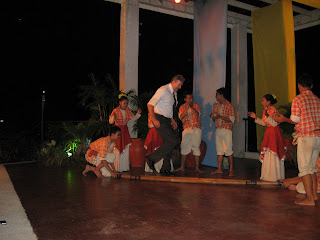 and this is Sister Parsons. Elder Parsons took the camera on stage with him when he went up, so that picture is left to your imagination.

 Well, that's all for now.
 and this is Sister Parsons. Elder Parsons took the camera on stage with him when he went up, so that picture is left to your imagination.
Now the ferry ride back was more the norm of how ferry boats are loaded to the hilt. We have never yet seen a ferry travel without at least one Ceres bus along for the ride. They're everywhere, they're everywhere!!
No we are not allowed to snorkel, but this wonderful camera we have even takes shots of fish under the water. We took this from the observation deck of the ferry before we left port to come back to Negros Island. The Zebra fish were plentiful.
Well, that's all for now. Elder and Sister Parsons


